Further help with Reductio
Topic
Logical System
Example of a difficult derivation
6/1/09 need to check


6/1/09 need to check
2013
You may have derivations of your own that you wish to try. Just type, paste, or drag and drop, them into the panel, select your derivation, and click 'Start from selection'. [Often copy-and-paste won't work directly from a Web Page; however, usually drag-and-drop will work!]
You will need to use the correct logical symbols. Here they are
F ∴ F & G ∼ & ∨ ⊃ ≡ ∀ ∃ ∴ (or use the palette to produce them)
4/24/06
4/24/06
4/24/06
4/24/06
To understand how the various restrictions on the quantificational rules work to exclude certain kinds of invalid inferences
Bergmann[2004] The Logic Book Section 10.1
If a derivation contains a line of the form
n (∀<variable>)<scope> <any justification>
then a line of the form
<<scope>[<constant>/<variable>]> 'n ∀E'
2013
Bergmann[2004] The Logic Book Section 10.1.
Existential Elimination (often called 'Existential Instantiation') permits you to remove an existential quantifier from a formula which has an existential quantifier as its main connective. It is one of those rules which involves the adoption and dropping of an extra assumption (like ∼I,⊃I,∨E, and ≡I).
The circumstance that Existential Instantiation gets invoked looks like this.
2013
Bergmann[2004] The Logic Book Section 10.1.
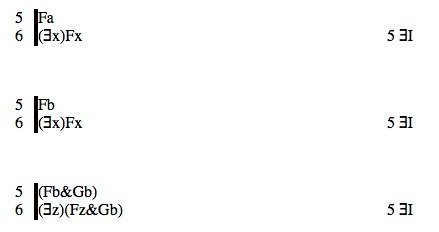
There is a rule for adding a Existential Quantifier, Existential Introduction (also commonly known as 'Existential Generalization'). This permits the step illustrated by the following proof fragments.