Review of K Propositional Rules
Logical System
There are the ordinary (non-modal) tree propositional rules plus
The Modal Negation (MN) rules


There are the ordinary (non-modal) tree propositional rules plus
The Modal Negation (MN) rules



Here the letters 'P' and 'Q' are being used to stand for entire well formed formulas (so, on a particular occasion, 'P' might stand for the atomic formula 'F' and, on another occasion, it might stand for the compound formula 'F&G').
You can try your own exercises here.
Here are a few hints
- You have to use the right (unicode/html) logical symbols. Check Writing symbols
The symbols in use here are ~ & ∨ →
≡

Set theory is an extensive topic introduced elsewhere. It can be written as a first order theory.
There is one axiom schema, Abstraction (or Comprehension), which can generate infinitely many axioms
∀y(yε{x:Φ[x]}≡Φ[y])
Axiom Schema of Abstraction (or Specification or Comprehension). The Set Builder Axiom Schema.
And a number of other axioms
It is common in this setting (which is arithmetic) to use functional terms like s(x), s(1), s(0) to mean the successor of x, 1, and 0, respectively. Equally common is the notation x', 1', and 0' to mean the same thing. The latter is quicker and shorter (though not semi-nmemonic)-- we will use it here.
Groups can be characterized by three proper symbols {=,+,0} (ie identity, one infix operator, we will use '+', and an identify element '0') and the three proper axioms
∀x∀y∀z((x+y)+z=x+(y+z)), (*associativity*)
∀x(x+0=x&0+x=x), (*identity element, right and left*)
∀x∃y(x+y=0&y+x=0) (*inverse*)
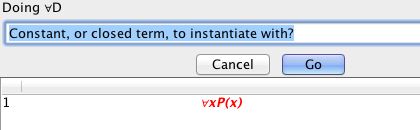
The word 'terms' in logic means 'names' and thus far we have met two kinds of terms: constants (or proper names), and variables.
To become familiar with the new rules for predicate logic trees with identity.
It is possible to use trees with formulas containing identity. Really there are two different ways to implement it: either there are two new rules, or there is one new rule and a new way of closing a branch from a single formula. Both will be described.